

In compliance with the U.S. Environmental Protection Agency’s (EPA) enhanced Lead and Copper Rule Revision (LCRR), CTUB has completed a Water Service Line Inventory and is committed to ensuring your drinking water is safe and free of lead. The primary purpose of the EPA’s LCRR is to identify homes that have lead water service lines. These were commonly installed prior to 1988.
The water leaving our filtration site is lead free, but it is important to understand where lead comes from and what you can do to reduce your exposure. Lead can get into water as it passes through household plumbing and/or faucets and fixtures that contain lead. Another source of lead in homes comes from paint. Lead can dissolve into the water from plumbing materials. That’s why it is so important to know your pipe type.
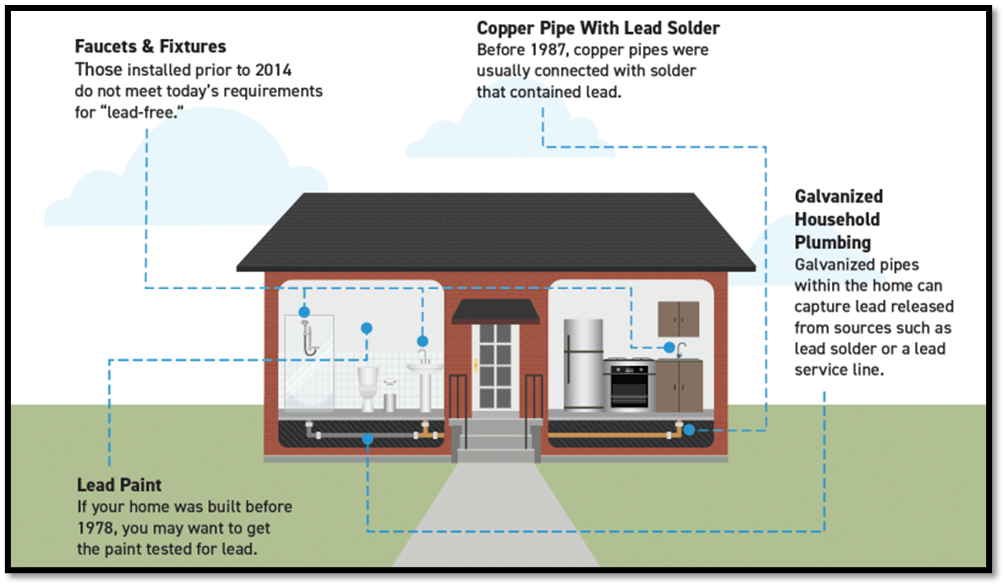
Faucets and Fixtures: Those installed prior to 2014 do not meet today’s requirements for “lead-free.”
Copper Pipe with Lead Solder: Before 1987, copper pipes were usually connected with solder that contained lead.
Galvanized Household Plumbing: Galvanized pipes within the home can capture lead released from sources such as lead solder or a lead service line.
Lead Paint: If your home was built before 1978, you may want to get the paint tested for lead.
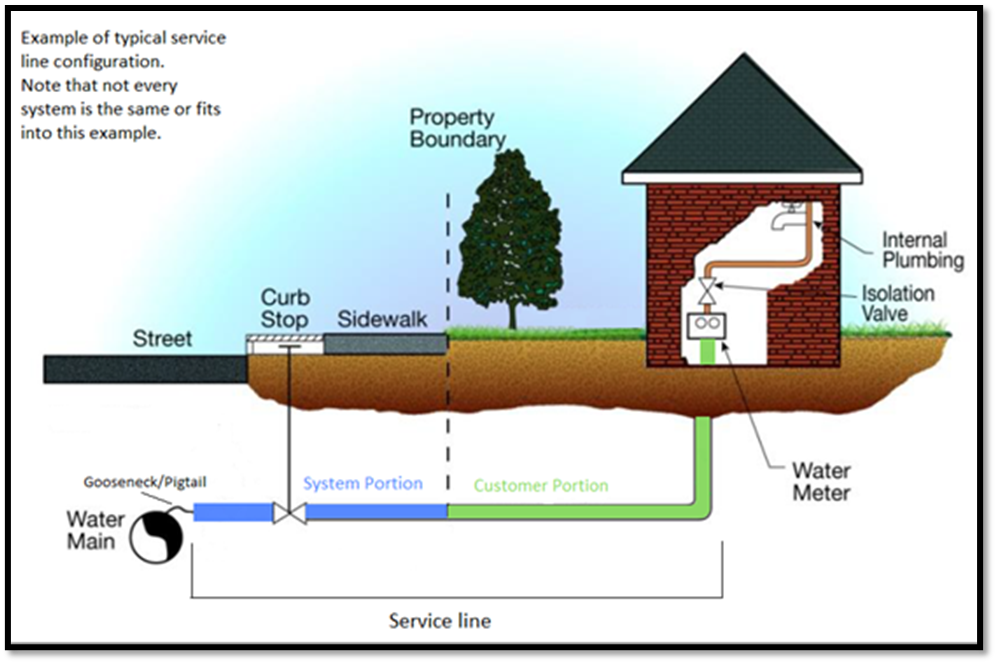
As part of the 2024 EPA Lead and Copper Rule Revision, CTUB has reviewed plumbing records dating back more than 40 years to create an inventory of the materials used for utility and customer-owned water service lines. In addition to records research, CTUB has performed visual inspection of all service lines where no records or information were available. A water service line is the pipe that carries water from CTUB’s water main to your property. The service lines contain a System-Owned and Customer Owned portion of the line as shown in the schematic below:
It is important to know that having a lead pipe in your home does not necessarily equate to lead exposure. CTUB uses an anti-corrosion chemical that prevents lead and other metals in the pipes from leaching into the water. What this corrosion inhibitor does is coat the inside of lead pipes and fixtures with a thin, protective layer that reduces leaching and flaking.
What’s in my drinking water?
Facts about lead in CTUB’s drinking water
- None of CTUB’s watermains or service line were built using lead materials.
- CTUB uses corrosion control measures in the form of zinc orthophosphate as an added level of protection against any lead that may have leached from solder on copper lines.
- Lead has been banned for use in household plumbing and solder since 1988 in West Virginia, so only homes built before then (or those with lead-containing fixtures) have a risk for lead.
- CTUB tests for the presence of lead in the internal plumbing of a random sampling of 30 homes once per year.
- Lead is not naturally present in our tap water, but it can dissolve into tap water when pipes in a water system or household plumbing that contain lead corrode over time.
- EPA’s current action level for lead in tap water is 15 parts per billion (ppb) for 90 percent of the samples taken. Not more than 10 percent of the samples can exceed this limit. The action level is not a public health threat trigger, but rather, a treatment technique trigger.
- To find out for certain if you have lead in your drinking water, have your water tested. Customers can also utilize the following tips:
- Use only cold water for drinking, cooking and making baby formula. Boiling water does not remove lead from water.
- Regularly clean your faucet’s screen.
- Consider using an NSF International water filter to remove lead and know when it’s time to replace the filter.
- Before drinking, flush your pipes by running your tap, taking a shower, doing laundry or a load of dishes.
- Some household filters, such as a pitcher or faucet mounted model, can reduce lead in tap water. To know if your filter is certified for lead reduction, go to www.NSF.org.
- Currently, CTUB shows non-detect levels of lead.
A summary of the records from the completed inventory are as follows:

To view the GIS map depicting the current results of the Water Service Line Inventory, please click here.

What is the customer owned portion of a water service line?
The water service line is the water line that runs from the meter into your home or business or from the property line to your home or business.
Does CTUB own all water lines?
CTUB owns all water lines extending from the water treatment plant to a resident’s/business’s water meter or property line (if a valve is present) if the meter is located inside to the structure. The line that runs from the water meter or valve at the property line to the structure is the responsibility of the property owner.
Does CTUB know the material of my water service line?
Prior to the EPA Lead and Copper Rule (LCRR) Inventory requirements, CTUB had limited inventory of private service line materials. The LCRR inventory is now complete and available on-line.
Why is CTUB conducting the water service line inventory?
This inventory is being conducted in response to recent Environmental Protection Agency (EPA) rules. These rules require that water utilities identify the material of water service lines in local homes, businesses, daycares, and schools.
What exactly is CTUB looking for in the water service line inventory?
We are primarily looking to identify two types of water service lines. The first are lead service lines. The second are galvanized steel lines that are, or have ever been, downstream from a lead pipe. These were commonly installed in homes constructed prior to 1986.
Why is the water service line inventory important?
Lead exposure can have serious long-term impacts on children’s health. The goal of the inventory is to identify and eventually eliminate lead water service lines and galvanized steel water service lines that have, or have ever been, downstream from lead lines.
Why is CTUB making my service line information public?
Doing so is required by the Department of Environmental Protection and the West Virginia Department of Health.
Why am I just hearing about this?
CTUB began communicating the Water Service Line Inventory in 2022. Frequent updates have been included in Utility Board meetings as well as published on our website.
What about my interior plumbing?
We are currently inventorying water service lines. However, interior water pipes and accoutrements are just as important as they too could contain lead or be made of galvanized steel. This includes soldered joints and old household plumbing fixtures. However, the current EPA requirement is the identification of lead and galvanized steel water service lines.
Does the presence of a lead line, solder or lead fixture mean that I have lead in my water?
No. CTUB uses a zinc orthophosphate that works as a corrosion inhibitor. This creates a mineral barrier inside pipes to prevent lead from leaching. This is one of the reasons why lead testing to date has required no action from a property owner or CTUB.
What if I find a lead or galvanized steel water service line?
If you do locate a lead or galvanized water service line, please call the CTUB office at (304) 725-2316. We will assist with verification and work with you to determine the best route forward in terms of replacing the service line.
What if I do not have the resources to replace a lead or galvanized steel water service line?
We are currently exploring options to assist those who have a verified lead or galvanized steel water service line. As viable options are identified, we’ll share this information with property owners that locate lead or galvanized steel water service lines.