

Poly- and Perfluoroalkyl Substances (PFAS) Overview and Current Activities
PFAS are a group of over 6,000 manmade synthetic substances that have been manufactured and used in home consumer products such as carpets, clothing, food packaging and nonstick cookware since the 1940’s. The substances are also used in the manufacturing or some electrical components and in the oil and gas industries. Two of these compounds – Perfluorooctanoic Acid (PFOA) and Perfluorooctanesulfonic Acid (PFOS) – which are both widely produced and used forms of PFAS, have been the most extensively produced and studied, and there is evidence that exposure to elevated levels of PFAS can lead to adverse health outcomes in humans. These chemicals are very resistant to degradation, treatment and removal and are persistent in the environment for extremely long times, even earning the nickname “forever chemicals”.
Water utilities are “passive receivers” of PFAS. They do not produce or manufacture PFAS. Instead, these chemicals may be present in source waters that are treated to produce drinking water. Additionally, our region is collaborating to identify manufacturing and industrial facilities that may be contributors of PFAS to area source waters.
Regulations for PFAS
The Environmental Protection Agency (EPA) is responsible for setting regulatory limits under the Federal Safe Drinking Water Act.
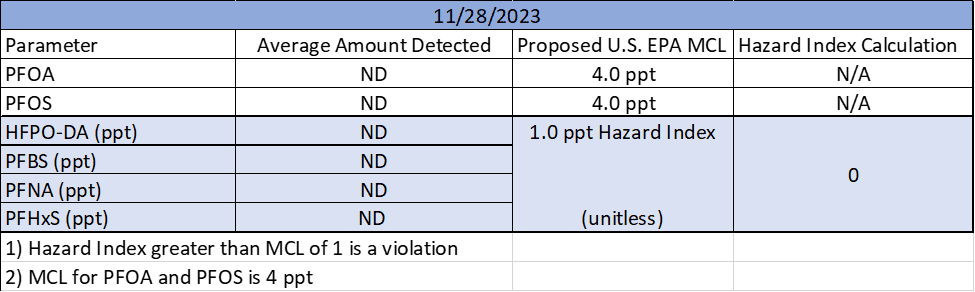
On April 10, 2024, EPA announced the final National Primary Drinking Water Regulation for six PFAS. PFOS and PFOA, have a proposed 4 ppt Maximum Contaminant Level (MCL) while the remaining 4 compounds (HFPO-DA, PFBS, PFNA and PFHxS) are grouped together with their analyzed concentrations weighted by their health-based water concentrations and summed. The summation of these values is designated the Hazard Index value (HI). The Maximum Contaminant Level Goal (MCLG) for this value is <1.
- According to the EPA, public water systems have five years (by 2029) to implement solutions that reduce these PFAS if monitoring shows that drinking water levels exceed these MCLs. CTUB will ensure that our water meets these standards.
CTUB began testing for PFAS pursuant to EPA’s Unregulated Contaminant Monitoring Rule (UCMR5) guidelines in the 1st quarter of 2023. You can see the results of these tests in the 2023 Consumer Confidence Report on CTUB’s website: CTUB-CCR-2023.pdf
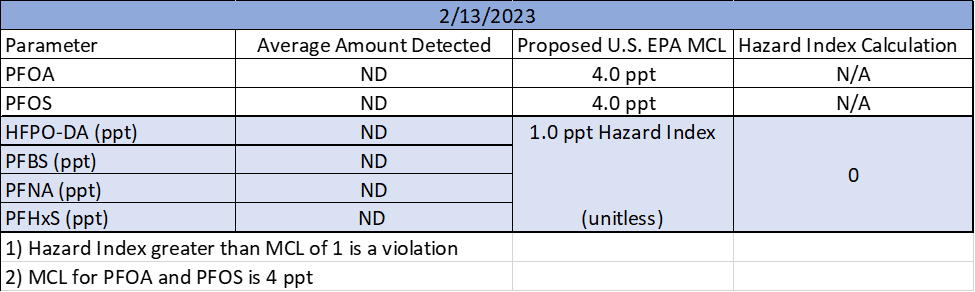
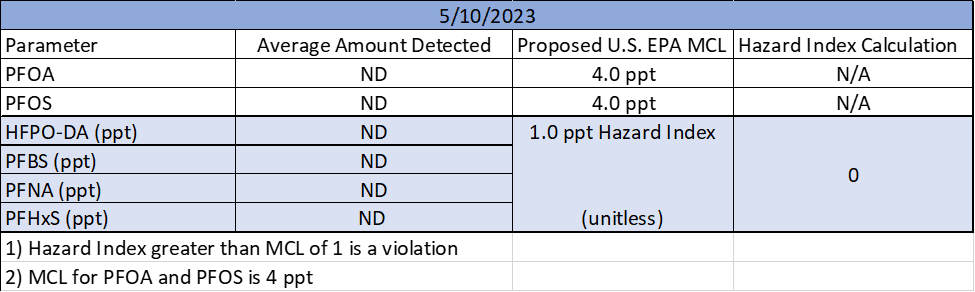
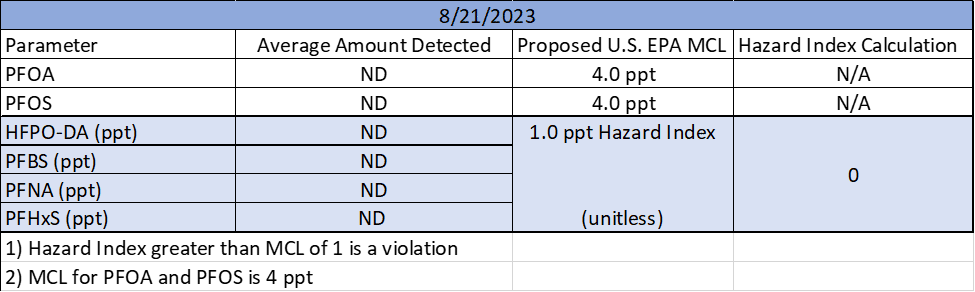
The 2023 testing results are as follows:
Summary:
- All results taken during the 2023 calendar year are non-detect (ND) which means that CTUB’s water is of an extremely high quality with no health concerns.
Next Steps:
- We are following the guidance of EPA and the West Virginia Department of Health and Human Resources.
- We will also continue to collect PFAS samples in 2024 and 2025 for the EPA’s UCMR5.
- We await further guidance and will take action if necessary to meet future state and federal regulations when they are established.
- We will actively collaborate with our regional and national partners to further learn and adapt to how we can monitor and address PFAS to ensure public health and safe drinking water.
Reducing Your Exposure to PFAS
- Support efforts to protect drinking water sources and keep PFAS out of water supplies.
- Cook with stainless steel, cast-iron, glass or ceramics. Don’t use nonstick cookware.
- Read ingredient lists and choose products without PTFE or perfluoro- or polyfluor-.
- Look for coats, hats and boots labeled water-resistant. They’re less likely to have PFAS than waterproof products.
- Make popcorns on the stove or in an air popper instead of microwave bags.
- Steer clear of ordering food in grease-resistant wrappers or containers.
- Avoid carpets and upholstery treated to be stain or water-resistant. Decline stain treatment.
- Ask manufacturers if their products contain PFAS. These chemicals are often not listed.
Additional Information:
EPA’s PFAS Information: Per- and Polyfluoroalkyl Substances (PFAS) | US EPA
EPA’s Questions and Answers: Drinking Water Health Advisories for PFOA, PFOS, GenX Chemicals and PFBS: Drinking Water Health Advisories (HAs) | US EPA